The yin Wood symbol
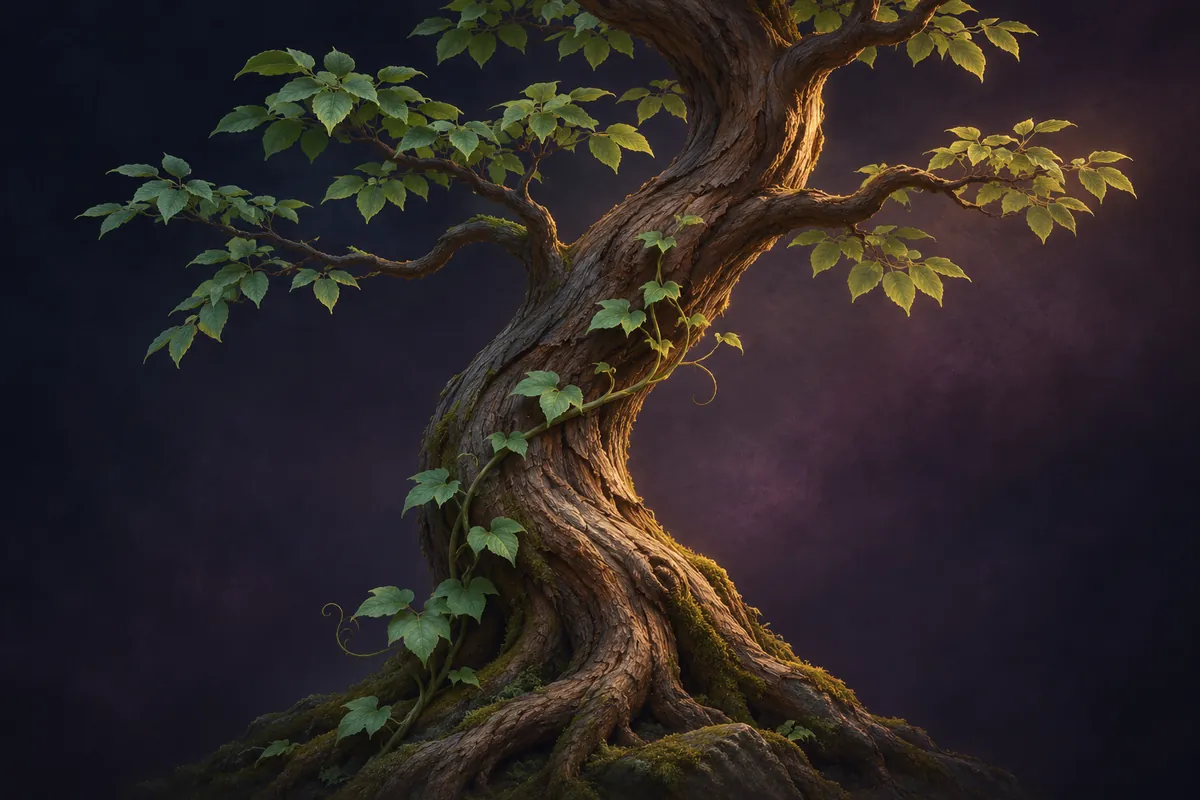
Yi shares the Wood element with Jia and differs in polarity. Traditional descriptions often use flowers, vines or smaller plants for Yi, while using a tree for Jia Yang Wood. These images help recall a distinction within the symbolic system; they do not determine temperament.
The useful technical difference is relational. Ding Fire is same-polarity output for Yi but opposite-polarity output for Jia. A description that changes only “tree” to “vine” misses that actual change in the chart labels.
Read the stem, then the branch below it
Look for 乙 as the upper character of the day pillar. In this example the pillar is Yi Hai: Yi Wood above Hai Water. Hai contains Ren Water and Jia Wood as hidden stems, while Yi remains the visible Day Master.
Hidden Jia does not replace Yi as the reference point. It has a Rob Wealth relationship to Yi because it is the same element with opposite polarity. The branch-content table shows why a branch can add relevant stems without adding another Day Master.
Follow the example’s output and control
Ding Yin Fire appears on the month stem. Wood produces Fire and both Yi and Ding are yin, making this Eating God. Bing Yang Fire inside the Si branches has the other output polarity and is Hurting Officer.
The hour stem is Xin Yin Metal. Metal controls Wood and Xin shares Yi’s yin polarity, so the hour stem is Seven Killings. The frightening translation does not make this a dangerous chart; it records a specific element and polarity relationship.
How Yi differs from Jia in a real lookup
Yin and yang do not change the Wood-to-Fire generating relationship. They change which Fire stem is Eating God. Starting from Yi, Ding is same-polarity output and Bing is opposite-polarity output. Starting from Jia, those two names exchange places.
Water demonstrates the reverse direction. Water produces Wood, so it belongs to Resource for both Wood Day Masters. Ren is Direct Resource for Yi, while Gui is Indirect Resource. These are useful distinctions when reading Hai, which contains Ren but not Gui. A branch’s principal Water label does not tell the whole story.
| Compared stem | For Yi 乙 | For Jia 甲 |
|---|---|---|
| 丁 Ding Yin Fire | Eating God | Hurting Officer |
| 丙 Bing Yang Fire | Hurting Officer | Eating God |
| 壬 Ren Yang Water | Direct Resource | Indirect Resource |
| 癸 Gui Yin Water | Indirect Resource | Direct Resource |
The day branch, hour stem and seasonal month
The Yi Hai day pillar is particularly useful for learning layers. Its visible Yi is the reference. Its hidden Ren produces Wood; its hidden Jia shares Wood with the opposite polarity. Neither hidden stem occupies the hour column, where the example instead shows Xin. Reading the positions separately gives three distinct observations: Resource below the day stem, a hidden peer, and visible control in the hour.
Chou, the month branch, locates the birth in the final part of the traditional winter season. This is a position in the solar-term calendar, not a report of the weather at the birthplace. Its hidden Gui is Indirect Resource for Yi, whereas Ren in Hai is Direct Resource. The season and the two Resource polarities offer concrete material to compare before any school-specific judgment about support.
Trace a complete sentence back to the chart
Try the sentence “This Yi chart shows both Resource polarities in hidden stems.” It is more informative than saying “Water supports Yi,” because its two supporting observations can be checked individually.
- Open the Hai day branch: Ren Water is Direct Resource.
- Open the Chou month branch: Gui Water is Indirect Resource.
- Return to the visible stems: neither of those Water stems appears there. Keep hidden evidence distinct from the visible count.
A vine metaphor cannot choose useful elements
It is tempting to say that a “plant” always needs a particular combination of Water, Earth and sunlight. That turns an image into a prescription without evaluating the chart or stating an interpretive method.
Use the element display and its counting rules to inspect the data first. The chart cannot tell you what to buy, whom to partner with or which occupation fits you on the basis of Yi alone.
Check every observation
The complete worked example
The fictional input produces Ji Si / Ding Chou / Yi Hai / Xin Si. Yi occupies the day stem. Ding on the month stem is Eating God; Xin on the hour stem is Seven Killings.
Inside the Hai day branch, Ren Water is Direct Resource and Jia Wood is Rob Wealth relative to Yi. The example therefore distinguishes the Day Master, the branch beneath it and the hidden relationships within that branch.
Open the full chart, hidden stems and highlighted Day Master
| Chart layer | year | month | dayDay Master | hour |
|---|---|---|---|---|
| Heavenly Stem | 己JiYin Earth | 丁DingYin Fire | 乙YiYin Wood | 辛XinYin Metal |
| Earthly Branch | 巳SiSnake · Fire | 丑ChouOx · Earth | 亥HaiPig · Water | 巳SiSnake · Fire |
| Stem relationship | Indirect Wealth | Eating God | Day Master | Seven Killings |
| Hidden Stems | 丙 BingHurting Officer戊 WuDirect Wealth庚 GengDirect Officer | 己 JiIndirect Wealth癸 GuiIndirect Resource辛 XinSeven Killings | 壬 RenDirect Resource甲 JiaRob Wealth | 丙 BingHurting Officer戊 WuDirect Wealth庚 GengDirect Officer |
Civil time · midnight day boundary · no solar-time correction. Read the calculation method.
Reproduce this example with 1990-01-10, 10:30, Asia/Shanghai. Method: civil-midnight-v1. The same engine powers the public tool. Enter these details in the free calculator to check the result.
A little more clarity
Frequently asked questions
Is Yi the same as a Rabbit zodiac sign?
No. Yi is a Heavenly Stem. Rabbit is the animal associated with the Mao branch, usually discussed through the year branch in zodiac descriptions.
Why is Ding Fire Eating God for Yi but not Jia?
Ding and Yi are both yin, so their output polarity matches. Jia is yang, making Ding its opposite-polarity output, Hurting Officer.
What does Hai add below the Yi day stem?
Hai contains Ren Water and Jia Wood. For Yi these are Direct Resource and Rob Wealth. Yi remains the one visible Day Master; the two hidden stems describe additional relationships.
How is Xin in this example’s hour pillar identified?
Xin is Yin Metal. Metal controls Yi’s Wood and both stems are yin, so the visible hour stem is Seven Killings. The result follows from direction and polarity, not the frightening translation.